

A lifelong bond, and hundreds of letters, between two women shows the importance of deep sharing

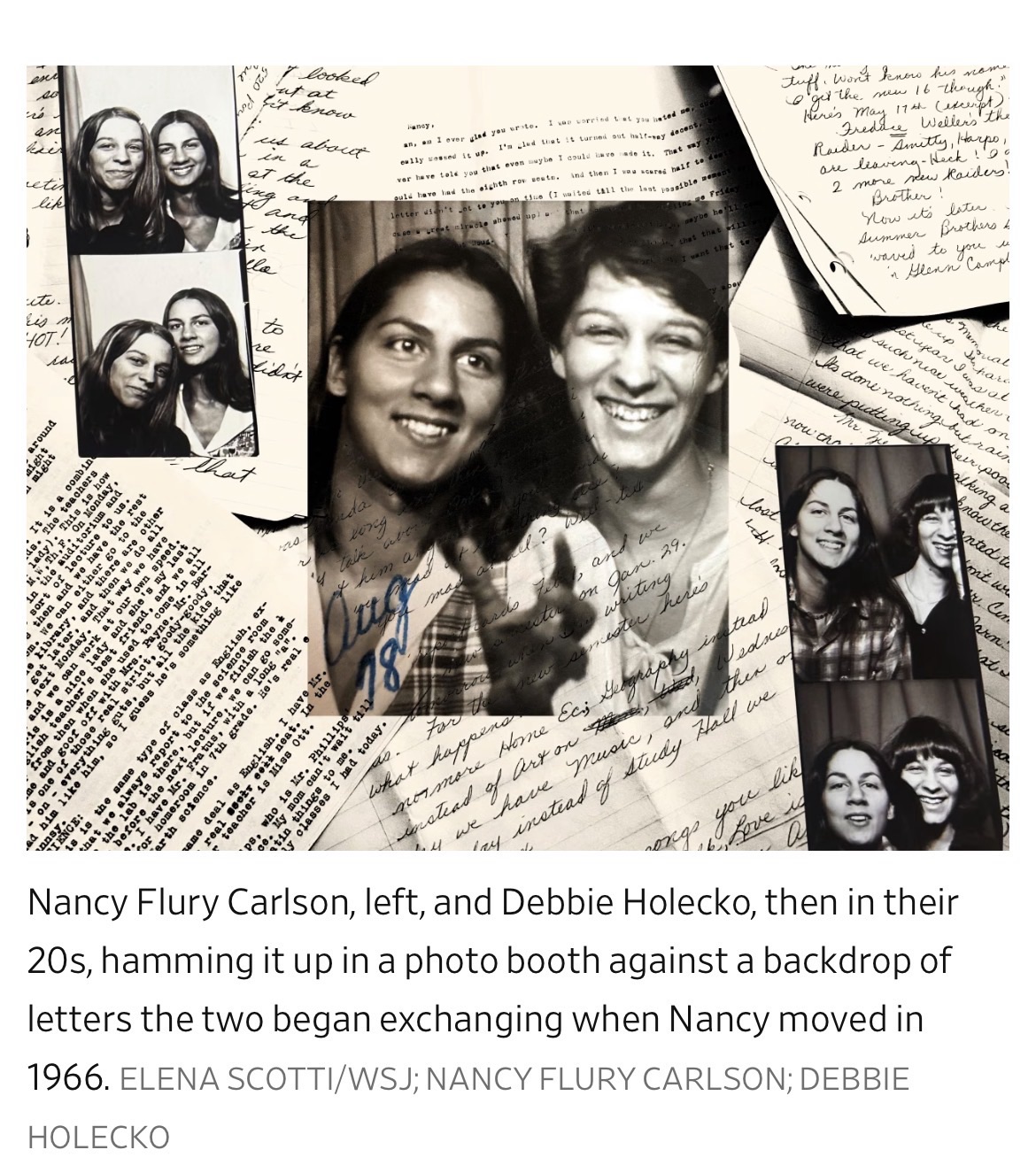
Nancy Flury Carlson, left, and Debbie Holecko, then in their 20s, hamming it up in a photo booth against a backdrop of letters the two began exchanging when Nancy moved in 1966. ELENA SCOTTI/WSJ; NANCY FLURY CARLSON; DEBBIE HOLECKO

By Clare AnsberryFollow
Updated May 26, 2026 at 4:52 pm ET
Nancy Flury Carlson and Debbie Holecko met in third grade and formed an unlikely bond.
They had different backgrounds and interests. Debbie’s dad worked in a factory. Nancy’s was an engineer. Nancy went away to college, traveled abroad for a high-school class trip, and had kids. Debbie didn’t. They don’t like the same music or shows and haven’t lived in the same state for 60 years.
And they are best friends. “I can tell her anything,” they say of each other.
That level of intimacy and emotional support, a feature of many close friendships, is often what sets women’s friendships apart. Men share, too, but not to the same degree. More than half—54%—of women are extremely or very likely to turn to a friend for emotional support, versus 38% of men, according to the Pew Research Center.

Nancy Flury Carlson and Debbie Holecko spent weeks together in the summer during their school years. ELENA SCOTTI/WSJ; NANCY FLURY CARLSON; DEBBIE HOLECKO
Likewise, women connect more frequently with their friends on a weekly basis, whether through calls or texts, than men. While men talk about sports and current events, women dive into personal realms like family and health, physical and mental. They talk more freely about being afraid, sad, frustrated and jealous.
Sharing those feelings deepens bonds. Close ties are good for us and provide health benefits. Having someone you can rely on and trust reduces stress and enhances well-being.
In fact, a significant number of women, one in three of those over 50, believe that female friendships create greater personal happiness than romantic relationships, according to a 2025 survey of 1,000 women in the U.S. by OnePoll and commissioned by Wooga, a mobile-games developer, whose games often feature female characters.
Nancy and Debbie clicked in grade school in part because they were both quiet, awkward and tall. They laughed at the same silly things and still do.
When Nancy moved a few years later from Youngstown, Ohio, where they met, the two began writing letters almost daily in study hall and at home, draped across their beds. They continued through high school and college.
At first, the letters were filled with updates about their pets, their siblings, their new classmates and then shifted into more serious realms. What to study, who to marry, where to live. They wrote about their worries, regrets, doubts, divorce, financial straits—being down to $35 in a checking and savings account—and a baby’s 104-degree fever.
Their missives were a priority. Debbie remembers making sure she wrote to Nancy before tackling college papers. Some letters were five pages long.
Jeffrey Hall, professor of communications studies at the University of Kansas, says a thoughtful, honest exchange is what matters in creating intimacy. It doesn’t have to be a five-page letter. Text or email works, too, he says.
The important thing is doing so regularly. “You have to keep at it.” About 40% of Americans long for more closeness with friends, he says, but struggle to find time for them.
Those who do prioritize their close friendships gain a greater appreciation of what their friends mean to them. They often discover that small differences don’t matter.
Debbie worked in the school cafeteria in fourth and fifth grade so she could eat free when her dad was on strike. She couldn’t afford to go away to college, or join college clubs because she worked after classes. Nancy did, which Debbie loved hearing about but didn’t resent.
“She had a lot more advantages than I did going to college. It was just the way things were,” says Debbie. “We didn’t let that get in our way.”

Best friends Nancy Flury Carlson, with her hand on her hip, and Debbie Holecko pose in front of a mirror in the late 1970s at Nancy’s parents’ home in St. Louis. They recreated the scene in 2026 at Nancy’s home in Pittsburgh. ELENA SCOTTI/WSJ; NANCY FLURY CARLSON; DEBBIE HOLECKO
Longer friendships tend to be more robustagainst minor conflicts, says Keelah Williams, a psychology professor at Hamilton College who studies social connections. “You’ve spent a lot of time and energy and effort on them. You don’t want to lose that investment,” says Williams.
Accepting differences also shows that you aren’t a fair-weather friend, she says, but someone who is going to be there if you need them.
After Debbie divorced, she sent a rambling letter to Nancy, saying how guilty she felt. Nancy quickly wrote back: “Try not to feel guilty about a divorce and try to think of it, not as a mistake but as several years in your life in which you learned some important things.”
Perhaps the biggest difference between the two and one that often causes friends to drift apart is children: when one woman has a child and the other doesn’t.
Debbie and Nancy were pregnant with their first child at the same time and eager to share that next chapter in their lives. Less than three months into her pregnancy, Debbie had a miscarriage, the first of three. She never had children. Nancy has a daughter and son.
“I felt bad. I knew what it was like to have a baby,” says Nancy. Debbie said it was hard but that she never felt cheated or jealous. She is the godmother of Nancy’s daughter.
The two women credit all the written and typed letters and what they shared through them for keeping them close. For Nancy’s 70th birthday, Debbie bought her friend a necklace with a pendant holding a Shift Lock key from a typewriter.
Appeared in the May 27, 2026, print edition as ‘What Sets Women’s Friendships Apart and Keeps Them Strong’.
Clare Ansberry writes the Turning Points column for The Wall Street Journal, exploring the various turning points in people’s lives. She was previously the Journal’s Pittsburgh
